

The U.S. labor market is downright confusing. AI is supposedly coming for everyone’s job, and yet you still can’t get a plumber to return your call. It’s a signal that is counter-intuitive, companies investing heavily in AI are also hiring more people.
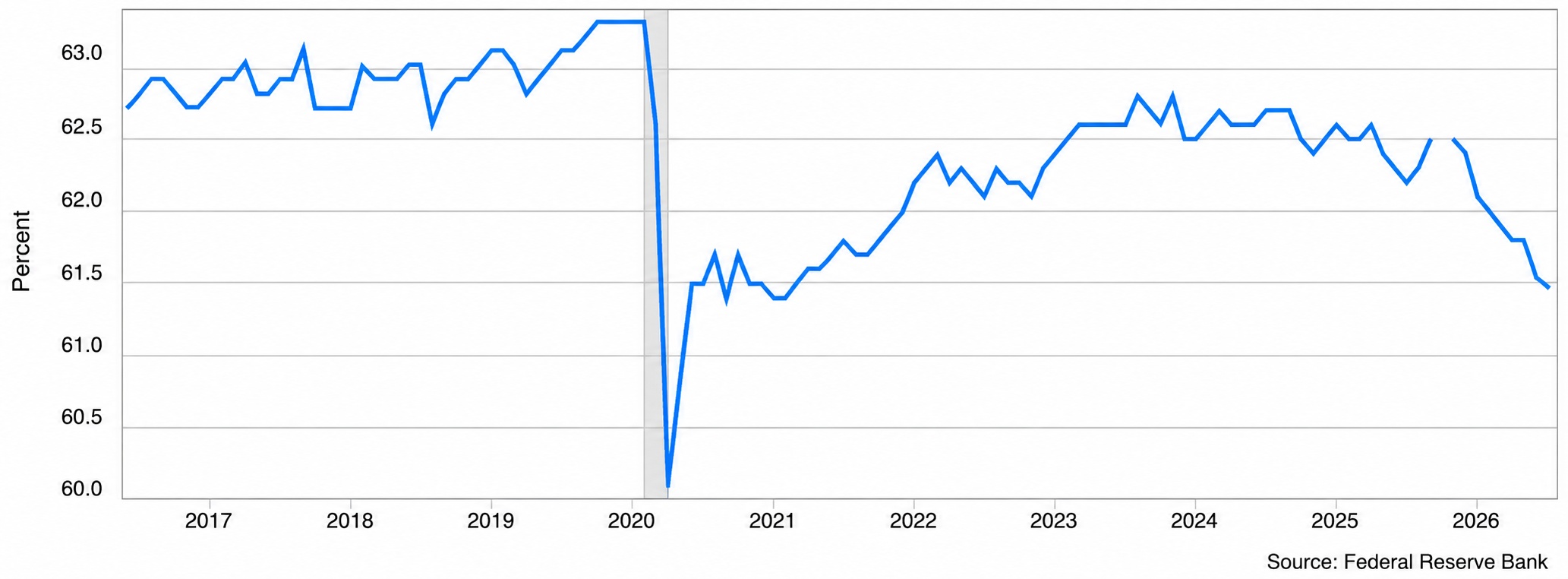
Unemployment looks stable, job openings remain healthy, and wages are still rising. However, labor force participation just dropped to 61.5%, the lowest level since the early post-pandemic recovery period, while 720,000 people left the labor force in June. The headline unemployment rate fell to 4.2%. The employment signals are muddy.
Labor Participation Rate
The June employment report showed only 57,000 net new payroll jobs, with April and May revised down by 74,000. Professional and business services added 36,000 jobs, social assistance added 25,000. Average hourly earnings rose 3.5% year over year, which suggests that demand for talent has not collapsed.
Employers still have open roles. Workers are not quitting with the confidence they had in 2021–2022. We have shifted from a no fire, no hire market to an approach of wait and see. With fewer workers to choose from employers will need to be even more intentional about who they hire and at what cost.
AI Employment

It has become a lazy narrative that AI simply destroys jobs. There is evidence that says that AI is splitting the labor market. PwC’s 2026 Global AI Jobs Barometer, based on more than one billion job ads, found that companies that are eking out productivity gains through AI, are hiring more people than the companies who are slow to deploy AI. PwC also found that skills in AI-exposed jobs are changing more than twice as fast as in less-exposed jobs, and that AI-exposed junior roles are increasingly requiring judgment, leadership, and strategic thinking earlier in careers.
Jobs Threatened by AI
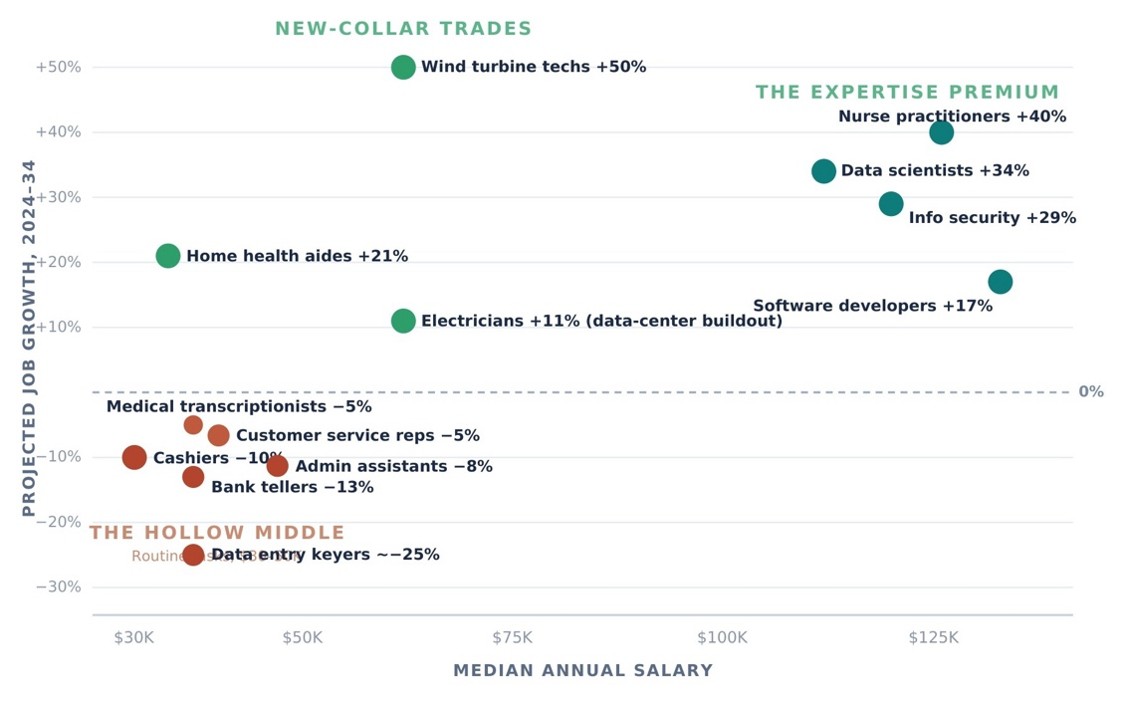
Companies using AI to expand capacity, speed, customer insight, engineering throughput, sales productivity, and decision quality may hire more, not less. The strategic question is no longer, “Will AI reduce headcount?” It is, “Which companies will convert AI into revenue per employee faster than competitors?”
Narcissists are Not Good Remote Employers
A recent Wharton-linked study reported that CEO narcissism was associated with stronger opposition to remote work. Researchers used proxies including CEO photo size in annual reports, signature size, and relative compensation. Higher narcissism scores correlated with more public opposition to remote and hybrid work. The unusual conclusion: some return-to-office mandates may be less about productivity and more about control, status, and visibility.
That does not mean remote work is always better. Some work absolutely benefits from proximity: apprenticeship, complex problem solving, culture formation, rapid escalation, and customer-facing coordination. But CEOs should be honest about the reason for the policy. “We need people in the office because our operating model depends on real-time collaboration” is a business argument. “I don’t trust people I can’t see” is a leadership tax. The winners will be the companies that redesign work fastest, deploy AI where it expands capacity, and build cultures measured by output instead of visibility.
Crypto Miners Selling AI Capacity

A new asset class is emerging. “AI infrastructure recyclers” built around crypto mining are now selling power, facilities, and data center capacity to AI customers. The logic: crypto miners already own or control power-heavy infrastructure, and AI needs enormous amounts of power, cooling, and compute space. Core Scientific signed large hosting agreements with CoreWeave, expanding contracted high-performance computing infrastructure to roughly 590 MW across six sites. TeraWulf signed 200+ MW AI hosting agreements with Fluidstack, with roughly $3.7 billion in contracted revenue and Google backstopping part of Fluidstack’s obligations. This new asset class will be front and central to the AI build-out.
Is Cuba Next?
Central and South America remain politically fragile. Bolivia is the latest powder keg: President Rodrigo Paz faces nationwide protests, roadblocks, austerity backlash, dollar shortages, and rising anger over economic reforms. Reuters reported Bolivia recently ended its 15-year dollar peg amid severe foreign-exchange pressure, while protests and road blockades have forced the government toward emergency measures.
The broader risk is that instability in the region collides with a more aggressive U.S. foreign policy posture. The Trump administration has already escalated pressure on Cuba, including the indictment of Raúl Castro over the 1996 shootdown of civilian planes that killed four Americans. Reuters reports the charges include conspiracy to kill U.S. nationals, murder, and destruction of aircraft.
The President has also suggested Cuba could become a future target after Iran. And while Cuba has already been isolated, its long-standing relationships with Russia and China, introduce new risks.
The U.S. is not only engaged in a war in the Middle East it is engaged in a Cold War with advisories that will seek out weaknesses to exploit. We should expect continued instability and should build business models agile and resilient enough to withstand this new normal.
Podcast: The Ins and Outs of Selling a Business, Episode – The Final Months of a Sale Can Make or Break Your Exit
A strong growth strategy can make the difference between an average valuation and a premium one. In this episode of The Ins and Outs of Selling a Business™, Keith Dee sits down with Marc Emmer, President of Optimize, Inc., to discuss why buyers invest in future growth, not just past performance.
White Paper: The Perfect Calendar, A Framework for Managing Time in a Distributed Workforce
As our clients have shifted toward distributed work, their ability to schedule, execute and optimize meetings has become mission critical.
The Strategy Experts

Marc Emmer is President of Optimize Inc. He is an author, speaker and consultant recognized as a thought leader throughout North America and as an expert in strategic planning.


