
Don’t believe what you hear on the 6 o’clock news about the end of capitalism.
As responsible capitalists, we believe regulation has its place, and markets need guardrails. But leave markets with the latitude to adjust and they respond faster than any government possibly could.
Consider international trade. Pundits thought tariffs imposed by the U.S. and reverse tariffs would lead to catastrophic events in the global economy. Year-to-date imports reached $2.66 trillion, up $48.8B (+1.9%). Exports grew much faster, up 12%.
The onset of the Iran war brought predictions of run-away fuel prices. When Iran began terrorizing the Strait of Hormuz, some analysts raised the alarm for $200 per barrel oil prices. Brent has spent much of September hovering near $100. For millions of Americans living paycheck to paycheck, the cost of energy is a significant strain, but for the most part, energy prices have stabilized.
The market adjusted.
Saudi Arabia pushed its East-West pipeline to about 7 million barrels a day, sending crude over land to Yanbu on the Red Sea. China reduced imports. The UAE used its Fujairah line to skip the Strait entirely. Tankers rerouted, insurers repriced and buyers rebalanced.
We hope for the best but prepare for the worst, and that is feeling like an elongated conflict with no end in sight. Yet, over time, one would expect energy prices to come down further. Because markets will adjust.
The Cost of Money
When inflation comes from a shock rather than real demand, one result is that money gets more expensive. On September 16th, new Fed Chair Kevin Warsh and the FOMC raised rates a quarter point, to 3.75% – 4.00%. It was the first hike since 2023. Many observers were relieved to find Warsh wasn’t under Trump’s thumb after all.
The vote was unanimous. In July the Fed held rates steady while three members dissented in favor of a hike. Thankfully, the Fed seems to remain independent.
The Fed had little choice but to raise rates. Banks were already charging more for credit. If the Fed had held, lenders would have kept the difference through wider credit spreads. The hike mostly confirmed borrowing costs that were already priced in the market.
A consequence of a higher borrowing cost is a slowing real estate market. This sounds eerily similar to 2008. The first shoe to drop was repackaged debt: mortgage-backed securities, CDOs and the credit default packaged in a way that investors didn’t know what they were buying. This was followed by a sudden drop in asset prices. It was a 1930s bank run with Bloomberg terminals. Of course, the banking system implemented controls after the liquidity crisis.
Home prices are softening in many markets even though demand still exceeds supply. While this market is very different than 2008, we should be on high alert. The Fed announced it is likely not done raising rates. While there is significant demand, the market could become depressed if asset values fall further:
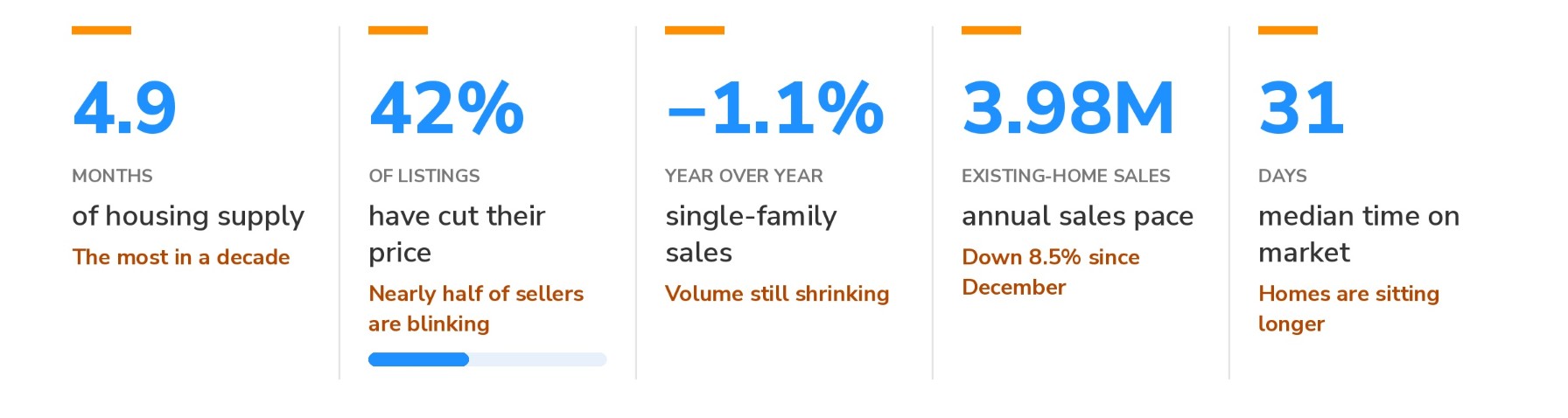
Drawing on 2008, we should recognize the broader impact that real estate has on our economy. Random shocks can knock a system out of balance fast.
GDP Goes Boom
Just days before the end of the quarter, The Fed’s GDPNow forecasting tool predicts Q3 GDP Growth of 3.7%. After adjustments are made the number could be lower, but this is a surprising number. Keep in mind, GDP is typically reported as “real” meaning not including inflation. So total prices would be up 6+%, during a time when the stock market just keeps running.
Subscriptions Under Pressure

Earlier this year Wall Street declared a SaaS apocalypse, out of fears AI and vibe coding would replace many forms of traditional software. After Snowflake’s blowout quarter in May, the main software ETF had its best two-day run since 2001. It appears AI will complement clunky systems and provide supplemental reporting and the like.
Now, it is subscription-based business models that are under attack. Gartner, the gold standard of research subscriptions, lost nearly half its value in 2025 as clients swapped paid analysts for AI tools. Freight broker C.H. Robinson fell as much as 24% in one day on automation fears. When one agent does the work of five analysts, customers need fewer seats.
The bigger shift is on the buying side. IDC reports that 80% of B2B tech buyers already use AI agents when they purchase. The bots are coming to the negotiating table. Make sure yours has a seat.
The Dividend Café: Unapologetic Energy Bull – Meet Me in the Middle

David Bahnsen hosts the Friday Dividend Cafe and explains why he chose to focus on an energy investment theme rather than the week’s surge in bond yields.
The Strategy Experts

Marc Emmer is President of Optimize Inc. He is an author, speaker and consultant recognized as a thought leader throughout North America and as an expert in strategic planning.


