

American corporations are having a moment. S&P 500 companies achieved 30% earnings growth in the third quarter, the third straight quarter of 25+% growth. On October 6th, the S&P 500 closed at a record above 7,800, its 28th all-time high of the year.
All this, while the U.S. is mired in a war with Iran and prices are 32% above a year ago. The 10-year Treasury crossed 5% in mid-September for the first time since 2007, then kept rolling. Last week it touched 5.32%, on track for its highest close since 2002. The Fed is debating rate hikes.
How is it possible companies are making so much money amid such poor fundamentals? There is only one explanation. Read on.
This year, the broader markets did not escalate solely as the result of the Magnificent Seven. All eleven sectors are expected to grow both earnings and revenue this quarter, with revenue up 12%. A record 72 S&P 500 companies issued positive guidance for Q3, the most since FactSet began tracking the metric in 2006. Yet tech stocks continue to fuel stock prices.
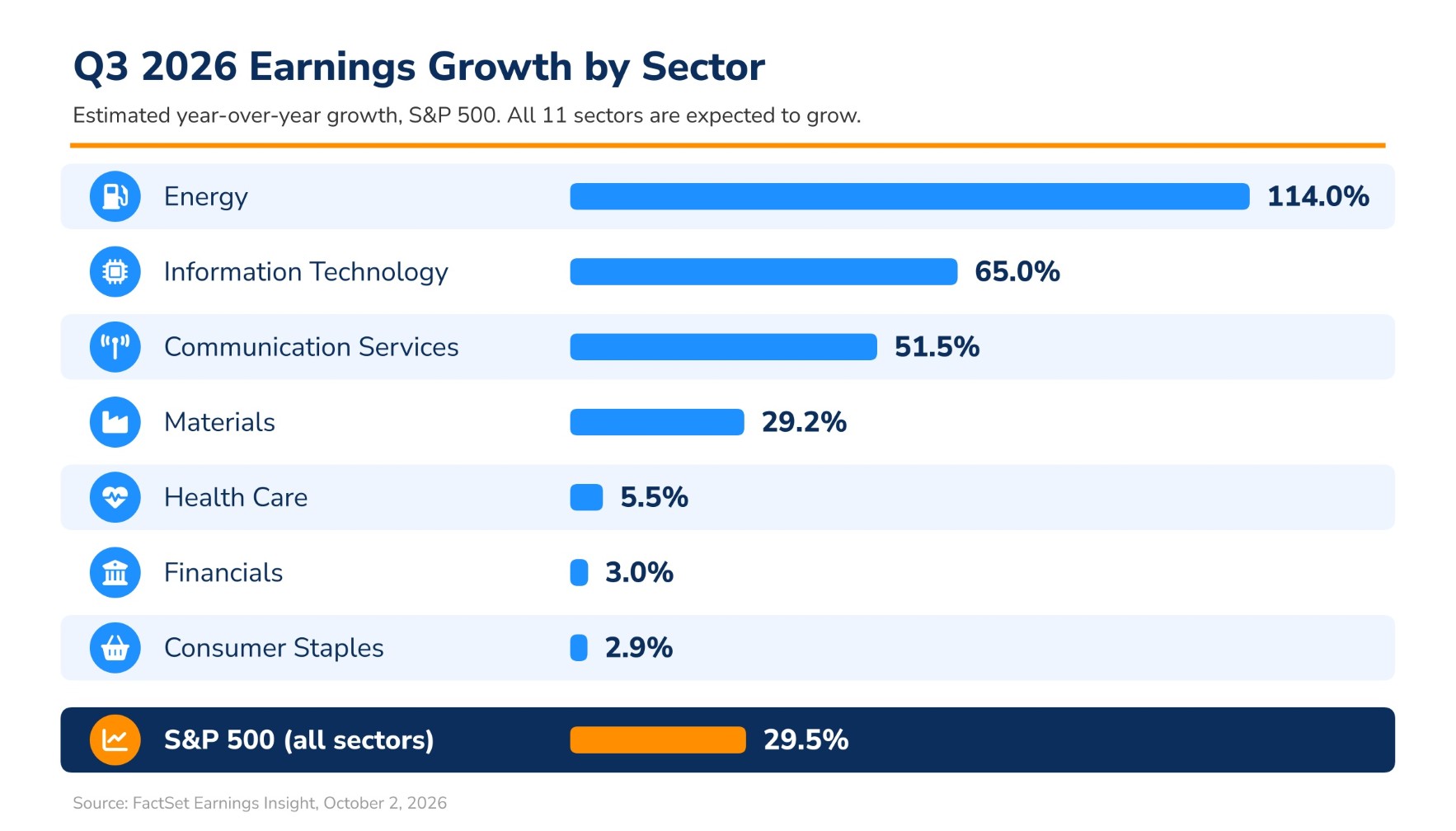
For many fund managers, 5% on the 10-year is the benchmark that triggers a sell-off, as the risk premium to earn 7-8% may be too great. Translation: this is not a hype rally.
Meanwhile, the economy keeps adding jobs. Slowly, but adding them. How is that possible? There is only one reasonable hypothesis. Under the surface, AI is quietly shifting U.S. productivity.
U.S. Productivity
The last jobs report was sluggish. Employers added just 29,000 jobs in September, and unemployment ticked up to 4.2%. Sluggish, but still positive.
That matters because job growth and productivity usually move in opposite directions. When hiring picks up, productivity tends to dip. The economy generates roughly the same dollars, more workers share the load, and output per worker falls. When layoffs hit, productivity jumps because the survivors carry the weight.
Not this time. Nonfarm productivity rose 1.4% in the second quarter, more than double the 0.6% economists expected, and 2.2% from a year ago. Output grew 2.5% while hours worked grew just 0.2%. Positive job growth and rising productivity at the same time is atypical.
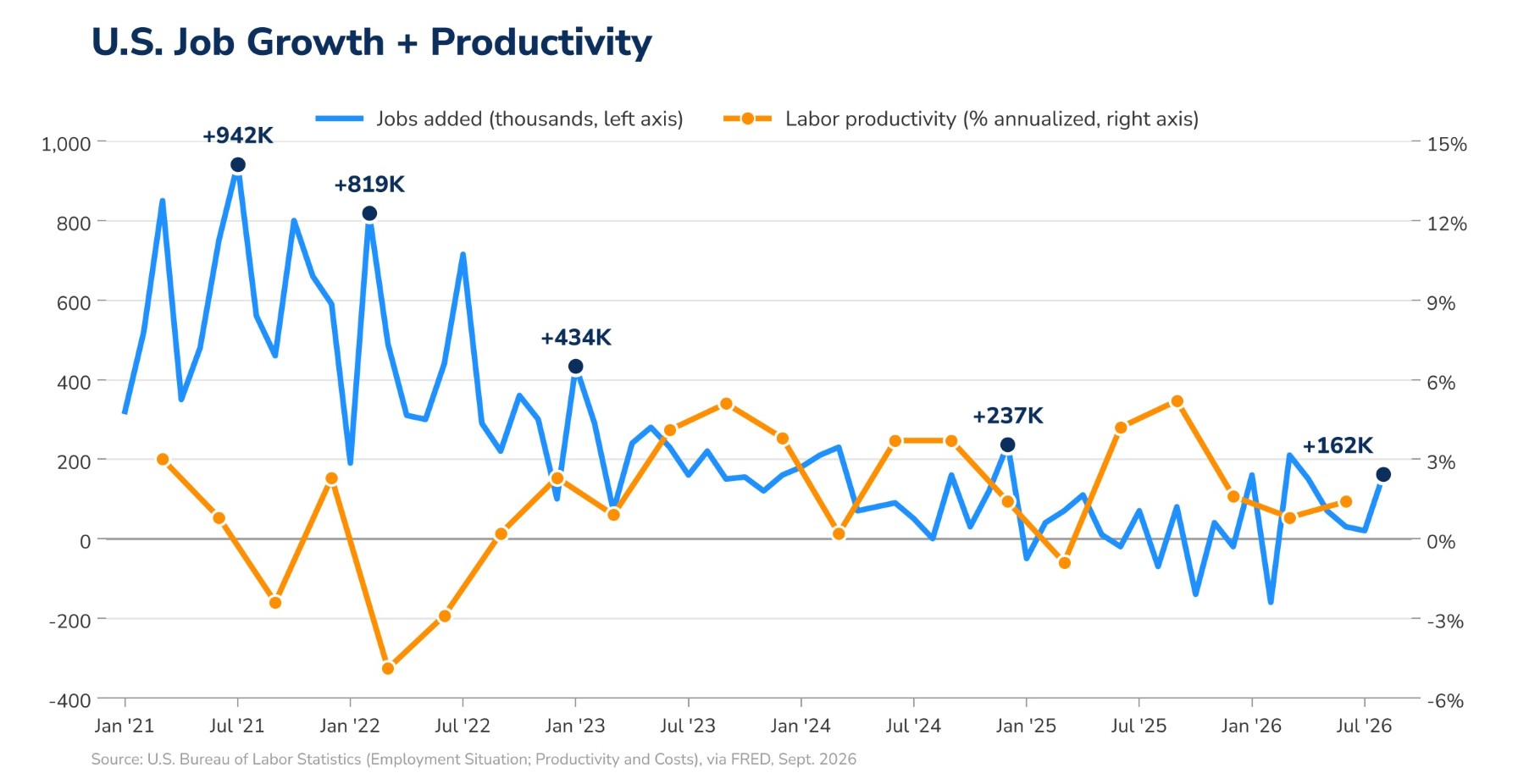
The Atlanta Fed surveyed nearly 750 executives and found AI productivity gains are real, expected to strengthen in 2026, and not yet costing jobs in aggregate.
Minor productivity gains translate into big profits. If the U.S. sustains 2.2% productivity growth rather than the 1.5% pace of the last business cycle it would result in $2 trillion of additional output every year. Productivity is compound interest for the U.S. economy.
Made in America Backlash

Earnings growth is also expanding during a time when U.S. companies are running into headwinds internationally. Over the last few decades, “Made in America” has been a slogan you didn’t need to explain. Times have changed.
American alcohol exports to the EU have fallen off a cliff. In Canada, where tensions are on the rise once again, they fell 85%. Tesla’s European sales fell sharply through most of 2025, in a market that still has an appetite for EV’s. Foreign markets are getting dicey for American exporters.
A study of nearly 100,000 online conversations found that hostility toward American brands isn’t a temporary condition. If you sell internationally and you’ve noticed deals slowing, or you are losing to other global competitors, it may be time to pivot.
The Backlash isn’t About the Product
Research from Charney Research, conducted for the American Marketing Association found that anti-American sentiment abroad targets the brands consumers know best, not the ones that sell the most abroad. Companies such as Amazon, Apple and Starbucks are hallmark names, facing intense pressure. The problem is not geared toward a company’s value proposition. It is a function of identity, and amazingly; a perception that American isn’t necessarily better.
This pattern is omnipresent. A branding professor at Royal Holloway told Newsweek that companies which built decades of equity around Americana, think Levi’s, Budweiser, Coca-Cola, are now exposed, precisely because they have spent decades building brands some customers may resent.
China’s New Positioning
If you’ve been selling into China on the strength of the “imported” label alone, it is time to reverse course.
The results are in. Handbag maker Songmont grew online handbag sales nearly 90% in the first nine months of 2025, the same period Gucci’s online handbag sales in China fell by more than fifty percent. This isn’t a fringe trend confined to streetwear; it is a state of being in cosmetics, food, electronics, and now higher-end fashion.
The nuance matters here, and it’s good news if you act on it. Research also shows guochao (a Chinese term that translates to national wave) isn’t a blanket rejection of international brands; it’s a desire for deeper localization. But it must be backed by real cultural fluency. Understand how the Chinese are using localization to their advantage, and you can create a version of it for your brand.
Europe is Building the Wall into Law
Europe’s shift is more structural. The European Commission has proposed a “Buy European” procurement overhaul. Unveiled on September 9, 2026, it would let public buyers reject bids with less than 50% European content on some contracts. This is a fork in the road. Public procurement is about 15% of EU GDP, roughly €2.5 trillion. American companies could easily be excluded.
This sentiment is compounding in other parts of the economy. Tesla’s European sales fell 49% year over year in April 2025 and kept falling. Analysts point to the aging lineup. But one of Tesla’s own investors, Ross Gerber, said Musk’s politics created “a huge amount of brand damage.” The lesson isn’t about Musk specifically, it’s that in a market with this much economic nationalism baked into both sentiment and law, your brand’s political and national associations are now a line on the P&L, whether you manage them or not.
The Companies Getting this Right are Running an Old Playbook
Here’s the historical parallel worth considering. This is exactly the position Japanese automakers were in during the 1980s. American resentment over auto industry job losses, tariffs, quotas, “Buy American” boycotts, threatened Japanese companies such as Toyota and Honda. They didn’t just win that fight back with slicker advertising about Japanese engineering prowess. They opened completely new plants in Georgetown, Kentucky and Marysville, Ohio, and hired Americans to work there. The backlash didn’t disappear because sentiment softened. Things improved because of the way companies repositioned.
American companies now need to run that same playbook.
Provide localized leadership. If the face of your business in Germany or Guangzhou is a U.S. expert flying in from headquarters, you’re reinforcing the wrong perception. Put local country leaders in front of local customers. Prove the company is invested in the market, not just extracting from it.
Decouple from the flag. Drop “American-made” as the headline and lead with the substance underneath it. If your value proposition features engineering rigor, reliability, service response, highlight your strengths.
Build local content into your operating model. With the EU’s procurement rules moving toward a 50% European-content threshold, you may need to consider options like local production.
Use technology to reduce distance. Provide region-specific content, local customer service trained on local norms rather than U.S. scripts.
Choose channel partners for their credibility, not their margins. A respected local distributor or reseller lends you their trust equity. Going direct under a purely American banner in a market like this is choosing the hard way for no strategic reason.
None of this requires abandoning who you are. It requires being honest that where you’re from has become part of what you’re selling, whether you planned for that or not.

The Hidden Cost of Poor Change Management
Learn more about our 7X7 Change Management System which will promote better execution within your organization.
The Secret Formula for Client Acquisition
The Strategy Experts

Marc Emmer is President of Optimize Inc. He is an author, speaker and consultant recognized as a thought leader throughout North America and as an expert in strategic planning.


