

The Asset Class Conundrum
We don’t dispense investment advice, so this commentary is more about the state of play in the economy. Investors find themselves in a pickle, given the widespread belief that there are few viable asset classes. As capital flowed out of commercial real estate and commodities, investors flocked to the safety of the U.S. stock market.
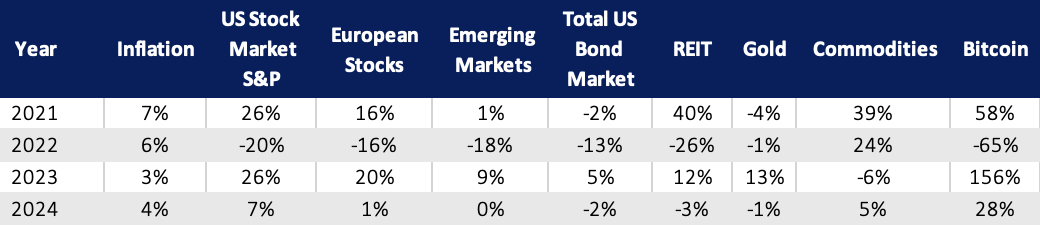
The “Magnificent Seven” of Microsoft, Apple, Nvidia, Amazon, Alphabet, Meta and Tesla now comprise about a third of the S&P’s value. This is an impressive run given that competing 6-month Treasuries are throwing off a 5%+ yield.
We weren’t the only ones who suggested a run on crypto once ETFs were made available to the masses. While Dogecoin and others seem fringey, we see a future for blockchain technologies. Renewables and alts, which seemed to have so much progress, have cooled.
Interest Rates in Quicksand

The economy added 140,000 jobs in February amid a minor uptick in labor participation rates over the last few months. This seems contradictory to a narrative that the Fed will raise rates 3-4 times in 2024.
Until total non-farm jobs growth reverses course, there will be sustained wage inflation. First analysts were talking about interest rate drops in May, and then June. One has to wonder if there will be any meaningful movement on rates this year.
Both sides will use Fed action as a political football during the presidential election. This creates a public relations problem for Jerome Powell, who may not be willing to move on rates in the October-November window. This could prompt the Fed to raise rates prematurely, or to wait until the end of the year.
Customization for the Masses

It’s clear to marketers that AI will enable personalization (or mass-customization as it is often known) online. For example, Proper Cloth asks you to take your own measurements, and cuts a custom business shirt to your specifications at a competitive price point. It ships from Vietnam in about 10 days.
As we’ve noted, major U.S. retailers cut available items during the holiday season, but they’re providing their customers with more ways to configure them. What happens when retailers compete with products that are custom-made, high quality, accessible, and sold at the same price? Providing customers the opportunity to configure to their precise requirement will be a path to competitive advantage in both B2C and B2B.
The Great Wage Debacle
We support a living wage for all humans. Governments must provide antitrust oversight and protect against abuses. But sometimes governments overreach in a way that defies logic.
On April 1, California’s fast-food minimum wage took effect. All the state’s fast-food restaurants are in a race to dramatically increase prices, reduce labor and implement robotic self-serve machines. The average California fast-food worker who made $16 an hour will get a 25% wage increase. Exempt California workers must earn double the minimum wage, meaning that supervisory personnel will make a minimum of $83,200 per year before benefits. Employers who compete with fast-food for labor already can’t find any, and the state has created an undue advantage for one business segment over another.
During Wendy’s dynamic pricing debacle, some said that increasing food prices in poor neighborhoods disproportionally injures the most vulnerable people. On its face, it appears the unintended consequences of this law are so destructive, they will outweigh any benefit to the people it was designed to support. Society would’ve been better off if the state had just increased minimum wage by the same amount across all industries. It’s outrageous to dictate that one type of restaurant should pay wages 20% higher than a different type of restaurant.
The government has a responsibility to regulate industries so there is no unfair competition–not to create more. If government officials want to support employment, creating a perverse incentive to automate is not the way to do it. Business leaders must continue to influence legislators so they make decisions that serve the public good.
Video by Marc Emmer

The Strategy Experts

Marc Emmer is President and Chief Strategist & Facilitator at Optimize Inc. He is an author, speaker and consultant recognized as a thought leader throughout North America as an expert in strategic planning.


