

We find ourselves in a bit of a kerfuffle. The real estate market is showing strain, and businesses feel constrained by higher interest rates. Trump is primed for an assault on the Federal Reserve. Yet GDP is growing, the labor market remains strong, and inflation is cooling but not fully contained. This was Powell’s message in his Congressional testimony last week.
The graph below illustrates the relationship between the Federal Funds Rate and CPI. Under normal economic conditions, the correlation is clear. When our economy is out of balance as it was during the 2008 financial crisis and the post-COVID period, monetary policy didn’t have the same impact.
In those periods, rate cuts failed to stimulate demand meaningfully because consumers and businesses were focused on survival over spending or investing. Likewise, rate hikes have less power when inflation is driven by supply shocks rather than demand. In our current environment, a rate increase could have the wrong effect—dampening productive economic growth without significantly accelerating disinflation. This raises the risk that monetary policy could become a blunt tool, solving the wrong problem at the wrong time.
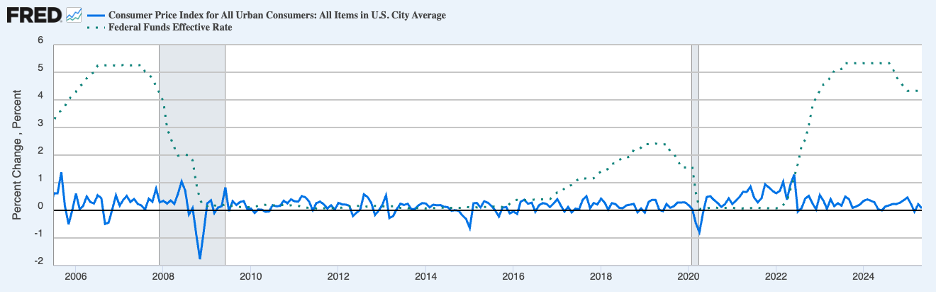
Source: Federal Reserve Bank Of St. Louis
Let’s be clear; this isn’t just cocktail party chatter among Wall Street insiders. There’s growing speculation that Federal Reserve Chair Jerome Powell’s days could be numbered. Could it happen? The answer is yes, there is a precedent.
The History of Presidential Influence on the Federal Reserve
Historically, presidents have occasionally sought to reshape the Fed when it didn’t align with their economic agendas. In the late 1970s, Jimmy Carter declined to reappoint Fed Chair Arthur Burns, and Ronald Reagan famously nudged then-chair Paul Volcker to adopt more growth-friendly policies. But outright firing a sitting Fed Chair mid-term? That’s almost unheard of. Trump flirted with this idea in 2018 when Powell’s aggressive rate hikes ruffled the administration’s feathers, but he ultimately didn’t pull the trigger. Yet Jerome Powell has been highly regarded, and such a move would be unpopular.
Why the Bond Market is a Blunt Force Instrument

If a new Chair more aligned with dovish policies were appointed, rates could come down faster. But here’s the reality check: the Fed isn’t a one-person show. Rate decisions require consensus among the 12 Federal Open Market Committee (FOMC) voting members. Swapping out the Chair doesn’t mean the rest of the committee abandons its mandate to fight inflation, protect employment, and preserve financial stability. Lowering rates prematurely—particularly with inflation still sticky in core sectors like housing and insurance—could ignite internal Fed pushback.
The bond market, however, would waste no time reacting. A politically motivated rate cut could send Treasury yields soaring. Why? Because bond investors would demand compensation for the increased risk of inflation not being properly tamed. The spread between short-term and long-term yields could invert sharply, signaling recession fears. Worse, the dollar might weaken, raising import costs and stoking inflation again.
It’s a high-stakes gamble, and the bond market has a long memory for when politics trumps sound monetary policy.
The New Playbook for CFOs
Once upon a time, CFOs were the high priests of spreadsheets—quietly crunching numbers, managing risk, and ensuring compliance. Today? They’re product managers for capital allocation, stewards of digital transformation, and strategic partners in driving growth. Welcome to CFO 3.0.
A perfect storm of sticky inflation, skyrocketing AI investment, and volatile capital markets has radically shifted the CFO playbook. The old formula (cut costs, optimize taxes, manage cash) isn’t enough anymore. Now CFOs must provide operational teams real-time financial data, empowering non-finance leaders to make capital decisions and use predictive analytics to manage risk before it happens.
This is where blockchain sneaks back into the conversation—as it democratizes finance. Blockchain is quietly reshaping how finance operates behind the scenes. Supply chain finance, audit trails, smart contracts, and instant settlement are blockchain applications with real traction in enterprise finance. IBM, Oracle, and SAP are already embedding blockchain in core ERP systems not because it’s trendy, but because it creates verifiable, tamper-proof data flows.
Imagine a world where intercompany transactions settle instantly, cross-border payments no longer take three days, and audits are conducted on a real-time, transparent ledger. That’s not crypto—it’s distributed ledger technology (DLT), and it’s moving faster than most realize. Even the U.S. Federal Reserve is piloting FedNow, a blockchain-adjacent instant payment system.
Clearly the role of CFOs is changing.
How Generative AI is Transforming Business Models

If you’re rolling your eyes at yet another AI headline, that’s fair. But here’s the thing: generative AI isn’t just changing how we write emails or automate chatbots. It’s fundamentally rewiring the DNA of business models.
Take customer support. What used to be a cost center is becoming a profit center, powered by AI agents that not only handle Tier 1 tickets, but also upsell and cross-sell, triaging with near-human proficiency. The result? Lower headcount, higher customer satisfaction, and entirely new revenue streams from AI-driven services.
In manufacturing, generative design allows AI to simulate thousands of prototypes in minutes, optimizing for weight, cost or efficiency. This not only saves time, but lets companies bring products to market faster with less R&D overhead.
Or consider SaaS companies. Traditionally, they charged subscription fees based on usage or seats. Now, AI-driven products are priced based on outcomes like fraud prevention rates, customer retention lift, or sales conversions. This outcome-based pricing is a tectonic shift that aligns vendor incentives with customer success in ways legacy models couldn’t.
And we’re only scratching the surface. Generative AI is moving from “cool toy” to “core engine.” Companies that embed it into workflows—not just for novelty, but for real, scalable transformation—will create moat-like advantages over slower-moving competitors.
By Marc Emmer for Inc: You Need to Use AI to Hyper-Specialize. Here’s How

During my keynote speeches across North America, I’ve been reinforcing a universal truth. Digital transformation isn’t about doing everything—it’s about hyper-specialization: doing one thing exceptionally well. With the emergence of AI, marketers now have the ability to deliver exactly the right message to precisely the right prospect, at the right time based on individual behaviors, geography, and psychographics.
By Marc Emmer for Vistage:
Marketing in 2025: AI, uncertainty and the hidden cost of standing still

In our annual analysis of marketing trends, we found that companies have pulled back on marketing investment as a result of economic uncertainty. To see a list of benchmarks and Marc Emmer’s recap on patterns in the evolving world of marketing, click here.
Video: Fed Chair Powell testifies before Senate banking panel on state of the U.S. economy
Federal Reserve Chair Jerome Powell is back Wednesday on Capitol Hill, this time speaking to the Senate banking committee as part of his semiannual monetary policy testimony. In his remarks Tuesday before the House Financial Services Committee, the central bank leader asserted that the Fed is “well positioned to wait” on interest rate policy as it watches the impact that tariffs will have on inflation.
The Strategy Experts

Marc Emmer is President and Chief Strategist & Facilitator at Optimize Inc.
He is an author, speaker and consultant recognized as a thought leader throughout North America as an expert in strategic planning.


