
Until the 1930s, it was believed that free markets were a self-correcting mechanism. Modern economics, developed by John Maynard Keynes during the Great Depression, emphasizes that markets don’t always self-correct quickly and government intervention is often necessary. The doctrine suggests that aggregate demand (total spending by households, businesses, and government) drives economic growth and employment.
Keynes advocated for active fiscal policies like government spending and tax cuts to boost demand and stabilize the economy. And the variable economists track most closely is the labor market and its impact on inflation.
For decades, when economists, CEOs, and policymakers debated labor markets, the conversation centered on demand—the willingness of companies to hire. When the economy heats up, businesses hire aggressively, and wages climb. Equity markets are fixated on this topic.
But the labor market of 2025 looks different. It’s no longer just about demand. In fact, many of today’s challenges are rooted in supply—how many workers are available, willing, and qualified to fill jobs.
A Shrinking Pool of Workers
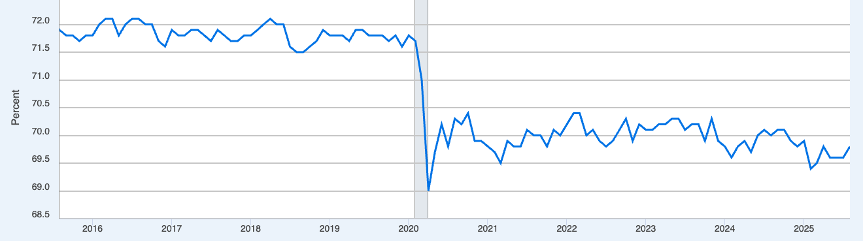
U.S. workforce participation has been stuck in quicksand since the pandemic. The most notable decline is among younger men, whose participation has dropped to levels not seen in decades. Some are in school, some are discouraged, others are simply opting out. While a small percentage, the proportion of people taking disability payments has doubled since 1990.
On top of that, demographics are working against us. Baby boomers are retiring in droves, and Gen Z isn’t yet large or prepared enough to backfill all those exits. There’s also an undersupply of workers with the skills required for today’s jobs.
Immigration Policy as a Lever
Immigration has historically been the shock absorber of the U.S. labor market. When domestic participation softens, foreign workers pick up the slack, particularly in industries like construction, agriculture, healthcare, and hospitality.
Yet policy uncertainty has created bottlenecks. Visa caps, lengthy processing, and political fights over border security have slowed the pipeline. From a purely economic perspective, more immigration would ease wage pressures and fill critical shortages. Instead, executives are left with fewer candidates in industries where margins are already razor-thin. And, visa limitations restrict access to tech talent at a time we need it most.
Demand Is Softening Too
Here’s the paradox: even as labor supply is tightening, demand for workers is also cooling. Job openings have fallen from their pandemic peaks. Wage inflation, which ran hot in 2022 and 2023, has moderated. Some industries like tech and finance have experienced waves of layoffs.
This is not the textbook scenario we’re used to. Usually when demand softens, supply is abundant. Or when supply tightens, demand is red-hot. But today we face both a shortage of supply and dampened demand.
How This Market Is Different
Economics is built on tidy variables—supply, demand, price. But in the real world, the labor market is messy. Historically, recessions and recoveries were driven by shifts in labor demand. This time, supply constraints are every bit as important.
That’s why simply watching job openings or unemployment rates doesn’t tell the whole story. A job posting in Iowa means little if there aren’t enough workers in the region, or if they lack the skills employers need. For executives, that means old playbooks won’t apply. Workforce planning requires a nuanced view of the equation.
Healthcare Costs Continue to Rise
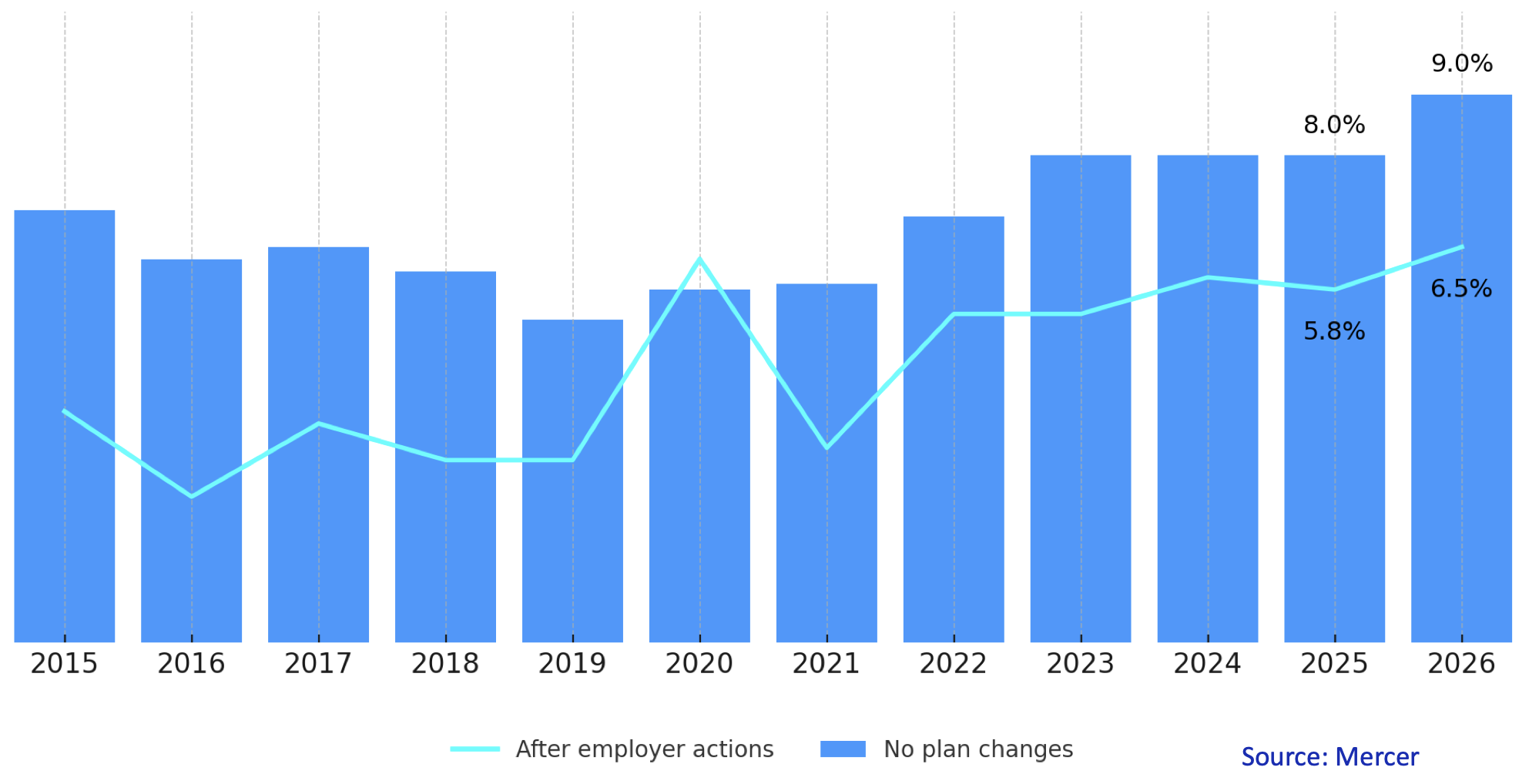
In a tease for my upcoming business trends webinar, healthcare inflation continues in earnest—expected to rise another 9% in 2026. Mitigations (a pleasant word for benefit cuts) by employers are expected to reduce cost increases to 6.5%. However, five years of such mitigations are taking their toll. Employers of choice are in a pickle as healthcare costs directly impact their profitability, and cuts dilute their employer brand. While wage inflation is softening, total costs are rising—yet another incentive to invest in technology and automation.
By Marc Emmer for Inc. – Retrieval Augmentation: A Better Way To Find Those Lost Files

As companies explore AI technologies they can deploy right away, retrieval augmentation (RAG) is emerging as a quick and easy win.
Marc’s Minute: 7×7 Change Management
Nov. 7 Webinar: Business Trends for 2026 and Beyond
Entering 2026, small and midsize businesses are navigating a world of constant change, shaped by rapid advancements in AI, shifting workforce dynamics, global instability, and economic uncertainty.
To help you make informed decisions, we will share our forecast for 2026, covering five key areas from our trends series:
- Economic
- Technology
- Social
- Artificial Intelligence
- Employment
These insights will reveal how you can turn trends in each of these areas into opportunities for growth and gain a lasting competitive edge for your business.
Date: November 7, 2025
Time: 1:00 p.m. ET / 10:00 a.m. PT
Freakonomics Radio: Is the U.S. Really Less Corrupt than China?
In this episode first published in 2021, the political scientist Yuen Yuen Ang argues that different forms of government create different styles of corruption — and that the U.S. and China have more in common than we’d like to admit.
The Strategy Playbook Masterclass

Have you joined our Strategy Masterclass? In this 10-part series, you will learn how to master the art of strategy.
Click below to subscribe for free.
The Strategy Experts

Marc Emmer is President and Chief Strategist & Facilitator at Optimize Inc. He is an author, speaker and consultant recognized as a thought leader throughout North America as an expert in strategic planning.


