

We offer three unrelated stories that weave a new picture on the state of play in AI.
A few weeks ago, Dario Amodei, CEO of Anthropic, released what can only be described as a manifesto on artificial intelligence. It reset expectations and not in the way that most of expected.
For the last two years, the narrative around AI has swung between extremes; either existential threat or silver bullet. Amodei rejects both. Instead, he frames AI as a powerful but imperfect system that will be embedded into decision-making long before it is fully reliable. And that’s where the danger lies. Perhaps the immediate threat is not Artificial General Intelligence (AGI). It could be overconfidence, or the other extreme, complacency.
This is what makes AI tools so frustrating. Performance can look impressive one month and degrade the next. AI fails in ways that are hard to predict.
For a management team this creates ambiguity about what to do next.
AI is not something you can “install” and trust. It must be managed, monitored, and governed, much like any other critical piece of infrastructure. The companies that win will not be the ones that adopt AI the fastest, but the ones that build the best processes around it.
At the same time, the competitive landscape is tightening. Claude has gained ground in enterprise settings where control and reliability matter, while OpenAI remains the default for scale.
Anthropic and ChatGPT’s models are broadly comparable in capability, though each performs better in different use cases. Anthropic has recently attracted significant attention, first for its engagement with the U.S. military, and even more so for its decision not to release a new version of Claude due to concerns that it may be too powerful. By pulling the carpet on the market, Anthropic has also created insatiable demand.
What is the lesson from all of this? AI isn’t a magic bullet. There are clearly accuracy issues. But those who invest and overcome them will certainly have a competitive advantage.
Trouble in Paradise

Walmart’s recent pullback from OpenAI over accuracy issues is a useful cautionary tale. At scale, even small error rates compound into real operational risk; mispriced items, flawed demand signals, and poor customer interactions.
What Walmart’s move highlights is not a rejection of AI, but another reset of expectations. Innovations can look impressive in controlled environments. But once deployed across thousands of SKUs, vendors, and customer touchpoints, inconsistencies surface quickly.
AI should be embedded where it augments judgment, not replaces it. You can’t replace a process that doesn’t exist. Pricing, forecasting, procurement, and customer service are all high-value use cases, but they require guardrails, validation layers, and clear accountability.
Our advice: move cautiously but swiftly.
Allbirds, All AI
Allbirds dropped a bombshell a couple of weeks ago.
Once positioned as a sustainability-first footwear brand, Allbirds built its identity around materials, mission, and story. But eventually, growth stalled, margins compressed, and differentiation faded as competitors caught up.
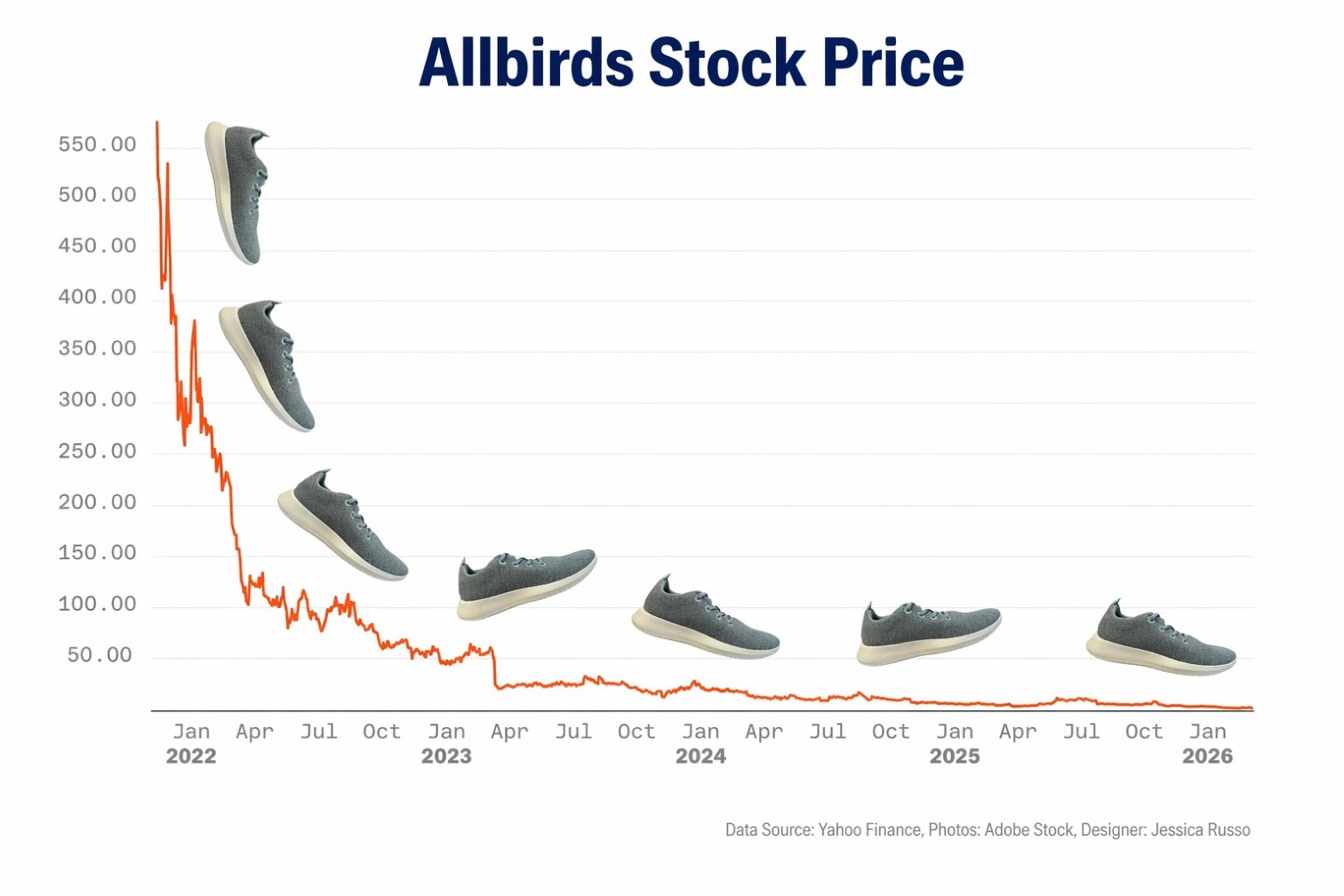
If there was ever a true strategic pivot, this is it.
In April, Allbirds sold its retail brand to the American Exchange group for only $39 Million, a massive devaluation from its $4 Billion IPO. Days later, the company announced it was repositioning as an AI enabled operating company, selling processing capacity. Its stock shot up 700%.
So here we are.
AI may not change the fundamentals of your business overnight. But it is just too big and too important to ignore.
Reality Check – Takeaways for CEOs
- Treat AI like infrastructure, not a tool. Assign ownership, define use cases, and build governance the same way you would for finance or safety.
- Start with high-friction processes. Target areas like estimating, AR, reporting, and project tracking, where small gains compound quickly.
- Implement human-in-the-loop controls. Require review for decisions that impact customers, contracts, or capital allocation.
- Track accuracy, not activity. Measure error rates, rework, and decision quality, not just usage or time saved.
- Standardize before you scale. Lock in prompts, workflows, and data inputs before rolling AI out broadly across teams.
Keeping it Real on Pricing

A couple of months ago, we wrote about the shifting universe of adaptive pricing. It resonated because CEOs were already feeling the squeeze from tariff shocks. Then the war hit, and volatility moved from a risk to a daily operating reality.
Energy costs are surging. Freight is unpredictable. Input pricing lacks any sense of stability. In response, companies are reaching for every lever available: fuel surcharges, escalation clauses, “temporary” fees that do not feel so temporary anymore.
But there is a tradeoff every provider should consider: protecting margin today can quietly erode trust tomorrow.
Customers, especially B2B, are more informed than ever. They can see commodity prices. They can benchmark competitors. When pricing starts to feel like a moving target or a gimmick, it doesn’t just create friction, it invites substitution.
We have seen this movie before. Short-term margin grabs often show up six months later as lost share.
So, what’s the play?
Anchor pricing to something objective
If you are going to move price, tie it to a transparent index (fuel, aluminum, freight). Show your math. Customers will tolerate increases; they won’t tolerate ambiguity.
Separate structural vs. temporary pricing
Do not blur the lines. If it’s a surcharge, call it that and define when it comes off. If it’s permanent, reset the base price. Mixing the two creates credibility risk.
Trade price for value, not just margin
If you are increasing prices, bundle the change with something tangible: faster delivery, better service levels, or guaranteed capacity. Price increases without perceived value feel like a tax.
Segment aggressively
Not all customers should be treated equally. Your most price-sensitive accounts need a different strategy than your most loyal or highest-margin relationships. Adaptive pricing is as much about segmentation as it is about cost recovery.
The bottom line: pricing is no longer a finance exercise; it is a brand decision. In volatile markets, the winners won’t be the ones who push price the hardest. They will be the ones who manage it with discipline, transparency, and a long-term view of customer equity.
Bill Hawfield
In Memoriam

A few weeks ago, we lost a friend of the program. Bill Hawfield was a friend, a colleague, and a mentor. As CEO of Penguins Yogurt, he defined a category. As a Board member he shaped entire companies. As a friend he offered a steady hand through his Southern charm.
At his Celebration of Life, people described being in “Bill’s orbit.” We are so grateful to have been in the orbit of such a wonderful human being.
YouTube – Exit Planning
Considering an exit? In this video we share how our clients have successfully optimized their value in advance of a diversture.
White Paper – The 5 Elements of Distinct Brands
While companies are looking to separate from the pack, uniqueness is elusive. In this white paper we share strategies that will make your brand distinct.
The Strategy Experts

Marc Emmer is President of Optimize Inc. He is an author, speaker and consultant recognized as a thought leader throughout North America and as an expert in strategic planning.


