
Have you ever wondered why the Middle East is such a powder keg? For thousands of years the region has been plagued with conflicts from Yemen to Iraq, Lebanon, Syria, and Israel.
Perhaps no topic garners more confirmation bias. People hear what they want to hear. For that reason, it is essential that we give homage to the past by seeking to understand one of the most contested pieces of land in the history of mankind.
Through the Middle Ages, a diverse population of Muslims, Christians, Kurds and Jews, coexisted under Islamic rule. Non-Muslims were subject to “dhimmi” status. They were not treated like second class citizens; they were second class citizens. Jews and Christians had to pay protection taxes for the right to live. Proof of payment often came in the form of necklaces granted after the tax was paid. The stars and other symbols worn by many Jews and Christians today are in remembrance of this period.
For nearly 400 years, through the early 20th century, the region was governed by the Ottoman Empire. When the Ottomans fell after World War I, European superpowers Britain and France, redrew the map of the Middle East, with little regard for local populations, cultures, languages, and religious divisions. These new borders often grouped rival ethnic and religious populations together, while leaving others, such as the Kurds, without a homeland.
In 1917, Britain issued the Balfour Declaration, supporting the establishment of a Jewish homeland and made commitments to Arab nations about independence. Through the 1920s and 1930s, under British rule, both Jewish and Arab populations grew increasingly nationalistic.
The breaking point came after World War II. In 1947, the United Nations proposed partitioning the holy land into two states, one Jewish and one Arab. After years of persecution in Europe including by the Nazis, the Jewish leaders accepted the plan; Arab leaders rejected it.
The British abandoned the area, and Israel declared independence in 1948. Within hours, neighboring Arab nations, including Egypt, Jordan, Syria, Lebanon, and Iraq attacked Isreal simultaneously. Isreal fought back and won more territory. Approximately 700,000 Palestinians were displaced, an event Palestinians call the Nakba, or catastrophe.
As a result of multiple other conflicts across Arab nations, the region was reshaped with Kurdish populations divided across Iran, Iraq, Turkey, and Syria. Iraq combined Sunni, Shia, and Kurdish populations, into a single state.
In the 1950s and 1960s, Arab nationalism rose under leaders such as Egypt’s Gamal Abdel Nasser, who sought to consolidate Arab power and eliminate Israel. In 1956, Egypt nationalized the Suez Canal, triggering a conflict involving Britain, France, and Israel. The Palestine Liberation Organization (PLO) emerged in the 1960s as the central political and militant body among Palestinians, gaining international recognition with observer status at the United Nations in 1974.
The 1967 Six-Day War was especially pivotal. Following a significant Egyptian military buildup in the Sinai Peninsula, the expulsion of UN peacekeepers, and the closure of the Straits of Tiran, Israel preempted the Egyptians, by attacking first. The conflict quickly expanded to include Jordan and Syria. By the end of the war, Israel had captured the West Bank, Gaza Strip, East Jerusalem, Sinai Peninsula, and Golan Heights.
As European influence declined, U.S. involvement in the region grew. In a historic step in 1979, Egypt’s Anwar Sadat formally recognized Israel, which triggered an international backlash. Shortly thereafter, Sadat was assassinated by his own forces. That same year, the Iranian Revolution replaced a pro-Western monarchy with an Islamic Republic led by Ayatollah Ruhollah Khomeini. Khomeini took American hostages, closed the Israeli embassy, and cut all ties with Isreal.
Soon after, Iraq, led by Saddam Hussein, invaded Iran, inciting a prolonged and devastating war (including Iraq’s use of chemical weapons) that ended in 1988 with no clear winner. In 1990, Iraq invaded Kuwait, prompting a response from a U.S. led coalition and expanding American military presence in the region. Palestinians backed Iraq, and since then, most Arab countries have banned immigration of Palestinian refugees.
At the 2000 Camp David Summit, brokered by President Bill Clinton, Israel offered a framework that would have returned roughly 90–95% of the West Bank and all of Gaza, leading to a Palestinian state. The PLO’s Yasser Arafat declined the proposal. In the last 10 years, the number of Palestinians on the Gaza strip has swelled by 20 percent.
The fractured Middle East has become a story of haves, and have-nots. Wealthy nations such as the UAE and Kuwait (who are mostly Sunni) wanted to protect the status quo and allowed the U.S. to build military bases there. The nations who have not prospered as much from the discovery of oil (and tend to be more Shia) chose to promote instability. Iran’s sponsoring of terror groups such as Hezbollah in Lebanon and Houthis in Yemen destabilized the region.
But perhaps the breaking point in the current construct of the Middle East came after indications the U.S. was brokering a deal between Saudia Arabia that included recognition of Isreal’s right to exist. What followed thereafter was the October 7th terrorist attacks by Hamas and the aftermath that followed. The powder keg ignited.
Today, complex issues remain unresolved, including Israeli settlements in contested territories, governance of Palestinian regions, and the lack of regional consensus on long-term solutions. For anyone to suggest that the current conflict began with a single recent event, whether a modern invasion or a terrorist attack, misses the depth of history.
So, what is the point of this post, and what solutions can be offered?
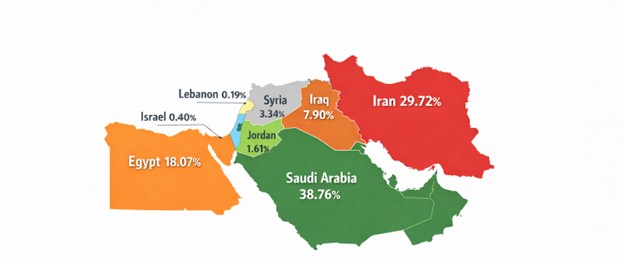
It does not seem like there can be peace without ethnic groups such as Jews, Palestinians, and Kurds having their own homelands. But this is not a U.S/Isreal problem, conflict in the Middle East is an existential threat to mankind. Isreal makes up less than 1% of the land mass of the Middle East. While Isreal is a melting pot of Jews, Muslims, and Christians, countries like Iraq, Iran and Saudi Arabia are entirely Muslim.
We all want peace. But to create peace that is sustainable requires more than cease fires and quick fixes. It will require that the superpowers of the world and regional neighbors agree to share land in a way that will satisfy the interests of all.
In the U.S., we are not immune to bigotry and racism. But for us to believe that we could understand the vitriol and hatred endured by minority groups within the Middle East is both arrogant and ignorant. For the U.K. and France to question how the region is policed after being unable to maintain peace themselves is the height of hypocrisy.
This may be a time when we need more constraint, but let us not kid ourselves, this is a war that has been going on for thousands of years.
Sources: History.com, CFR, the Encyclopedia Britannica and Wikipedia.
Leveraging Adaptive Pricing for Competitive Advantage

In today’s volatile environment, driven by inflation, supply chain shifts, and changing demand pricing has become a critical leadership lever. In a Vistage Research Post: The CEO’s Playbook for Adaptive Pricing emphasizes moving from static models to real-time, data-driven pricing strategies that protect margins while maintaining customer trust. The core takeaway: in a world of variable costs, fixed pricing is a liability, adaptive pricing is a competitive advantage.
The New Pharma Super Cycle

The pharmaceutical sector is quietly entering one of the most critical growth cycles in decades, one driven less by economic swings and more by population shifts and technology.
Global pharma is growing at roughly 6-7% CAGR, with total spend now exceeding $1.6 trillion annually. The growth is not evenly distributed, it is concentrated in oncology, immunology, diabetes, and obesity, all conditions tightly correlated with aging. As life expectancy increases, so does the prevalence of chronic disease. In practical terms, patients are no longer “treated” they are managed over decades.
On the supply side, AI is becoming a force multiplier. Estimates suggest AI could generate $350-$410 billion annually in value for pharma, powering roughly 30% of new drug discovery. This aligns with broader trends where AI is accelerating productivity across industries. Early data shows development timelines shrinking by years, with costs falling 20-30%.
The Problem with Robots

Companies are moving aggressively to deploy humanoid robots into real-world environments, particularly in logistics, manufacturing, and warehousing. Startups like Agility Robotics (maker of “Digit”), Boston Dynamics, Apptronik, and Figure are all racing to solve labor shortages and improve productivity. Amazon and GXO have already piloted these robots in controlled environments, where they handle repetitive tasks like moving containers or sorting goods. The promise is clear: augment human labor, not replace it, while driving efficiency gains in tight labor markets.
But there is a catch, under current federal safety standards (largely governed by OSHA), robots must be physically separated from human workers unless they can reliably detect and respond to human presence. Today’s humanoid systems still struggle with that level of perception.
That constraint is about to change. Agility has indicated its next-generation Digit will include advanced vision systems, sensors, and AI-driven perception that allow safe human interaction. Over the next 12-18 months, improvements in machine vision, edge computing, and real-time decisioning will likely unlock “co-bot” environments, where humans and robots work side-by-side.
The Perfect Calendar

The Perfect Calander outlines a practical system for prioritizing daily actions through disciplined calendar management. By organizing time as a strategic asset, it offers a clear path for scaling organizations without losing focus or momentum.
The Strategy Experts

Marc Emmer is President of Optimize Inc. He is an author, speaker and consultant recognized as a thought leader throughout North America and as an expert in strategic planning.


