

Among America’s most significant problems are imbalances in our wealth and demographics. Americans are getting older, leaving the workforce, and leaning on a Social Security system that functions like a Ponzi scheme. We are moving to a form of generational warfare. Not only is there separation between the haves and have nots, but a growing divide between the old and the young.
Consider the events leading to the guilty plea entered last week by Luigi Mangione, in the killing of UnitedHealthcare CEO Brian Thompson. Thompson represented an elite, operating within a health care system perceived as being unfair. We were startled by younger Americans celebrating the assassination of a CEO. But that is the state of play in a society where not everyone participates in prosperity.
There is also a swelling of support for Universal Basic Income, a pseudo-socialist idea, that pits older Americans, already due to receive Social Security, against younger American’s who seem to be believe they are entitled to income from the government. Some believe UBI will be facilitated by AI.
The top 10% of American households now hold roughly two-thirds of the country’s wealth. The top 1% alone controls more than 31%, the highest share on record since the Fed started tracking it in 1989. The bottom half of the country possesses about 2.5% of the nation’s wealth.
Boomers benefited from the generation before them, but younger generations don’t seem to be maintaining that momentum. A surging stock market, a generation of inherited wealth, and a tax code that rewards property ownership have created imbalances between the old and the young.
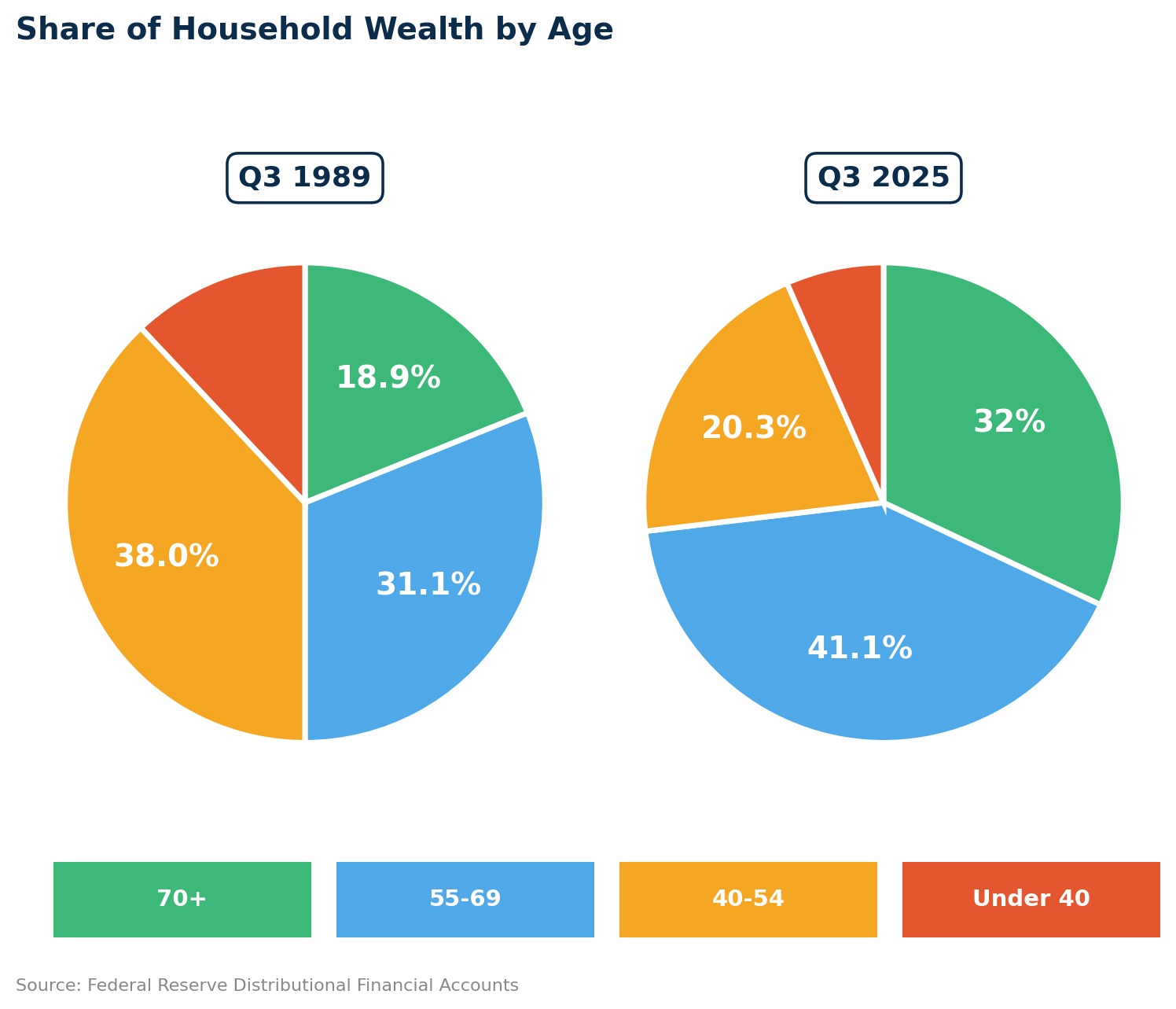
The Declining Middle Class
A non-prosperous middle class creates a drag on the entire economy. Consumer spending drives roughly 70% of U.S. GDP, and the middle class has historically been the most reliable spender in that equation, steady, broad-based, and less volatile than either the ultra-wealthy or the working poor. When that group loses purchasing power, aggregate demand softens even if headline employment numbers look healthy because people are working but not spending the way a growing economy needs them to. This shows up in slower velocity of money, weaker tax revenue at every level of government, and a widening reliance on consumer debt just to maintain a lifestyle that used to run on wages alone.
Income inequality hurts all of us and exacerbates the wedge between the old and the young.
Social Security Crisis
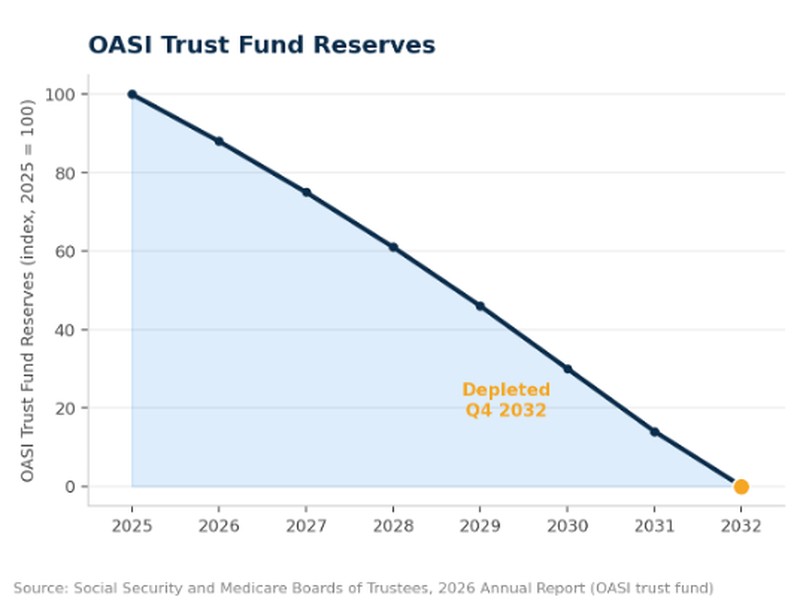
The 2026 Trustees Report confirmed the retirement trust fund runs dry in late 2032. After that, without Congressional action, benefits get cut automatically by roughly 22%.
Fewer workers are supporting more retirees for longer stretches. We’ve said on these pages before that Social Security and the tax code need radical restructuring, and every year that the politicians wait, the fix gets more painful.
When politicians and pundits float means-testing Social Security for wealthier retirees, those who have been paying into the system feel like they may be shorted on an IOU that is coming due. Scott Galloway has publicly asked whether wealthy retirees should collect Social Security at all. Washington has zero appetite to address the problem.
For certain, one thing the government will do is raise the retirement age. It’s the easiest lever available; a layup compared to the other potential structural changes. The fact that they haven’t pulled the lever yet is proof of their inability to act.
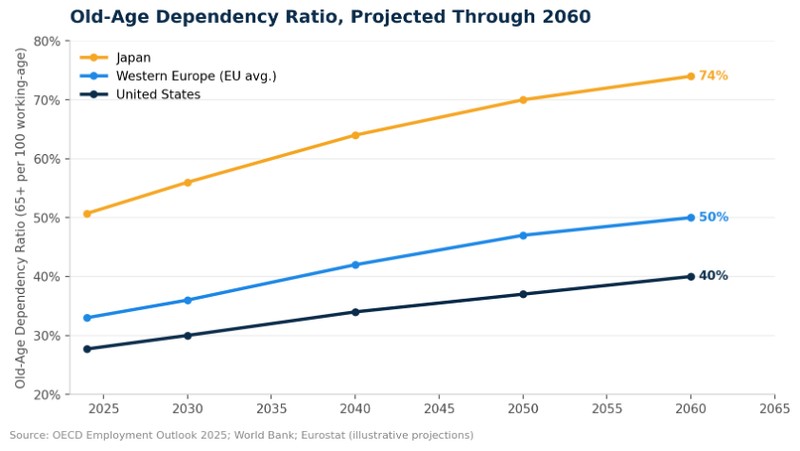
And America is not alone. Japan’s old-age dependency ratio has more than doubled since the 1990s and is projected to hit roughly 74% by 2060, meaning fewer than one and a half working-age people for every retiree. Much of Europe is heading down the same road.
The wealth gap, the aging workforce, and a Social Security system on borrowed time are three symptoms of the same underlying condition: a country whose demographics changed faster than its institutions have. Politicians will eventually act, because they’ll have no other choice.
The longer they wait, the more radical the fix will have to be.
AI Compute is the Currency of the Digital Age

If you need further evidence of the magnitude of the AI build-out, consider this genuinely staggering story. Terafab, the joint Tesla/SpaceX semiconductor mega factory in Grimes County, Texas will be the biggest building in the world. I guess they really do things bigger in Texas.
100 million square feet at full build-out. For reference, the Pentagon is 6.5 million square feet.
The project is a $119 billion investment across four phases, with $16.8B committed in phase one. That’s not a data center, that’s a company-state. What goes in it: Logic chips, memory, packaging, and testing, all vertically integrated under one roof. The output feeds Tesla’s Optimus robots and Cybercabs plus SpaceX’s planned space-based data centers.
Musk is essentially building the supply chain for his own AI/robotics empire, 3,000+ jobs, heavily sourced from Grimes and Brazos counties, which is how you get Texas to hand you incentives at this scale.
It has become evident that AI compute is the currency of the digital age.
Podcast: The Vision Architect
with Marc Emmer
Strategy is prioritization, focusing limited resources to win. Many teams confuse it with discussion, leaving without clear goals. Treat strategy as a cycle, not an event: prepare with data (market studies, customer input), then cascade goals, KPIs, and budgets.
Trends Webinar, Nov 13th: Business Trends for 2027 and Beyond

As CEOs plan for 2027, they continue to navigate the new realities that shape how companies compete, including global uncertainty and constant change. Rapid advancements in AI, shifting workforce dynamics, constant instability, and economic uncertainty are all underlying factors to consider when planning for the future.
The Strategy Experts

Marc Emmer is President of Optimize Inc. He is an author, speaker and consultant recognized as a thought leader throughout North America and as an expert in strategic planning.


