
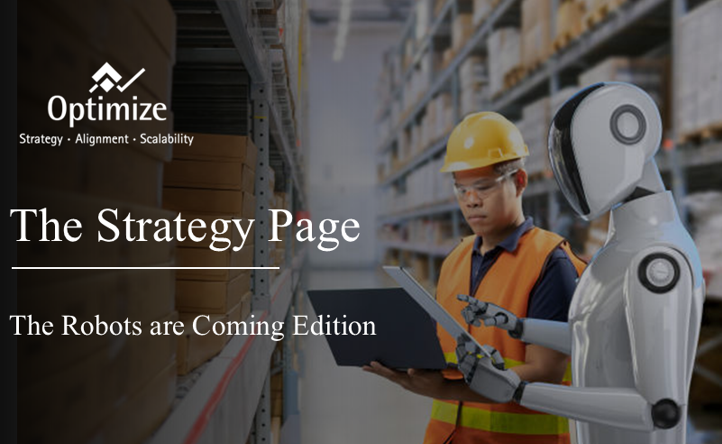
The Consumer Electronics Show, held each January in Las Vegas, has always been a crystal ball for where technology is heading next. And this year, it was dominated by robots.
These weren’t clunky prototypes or sci-fi fantasies. The robotics on display were practical, purpose-built, and clearly aimed at commercial and consumer use. From warehouse automation and manufacturing assistants to service robots designed for healthcare, hospitality, and even home environments, the message was unmistakable: robotics is moving out of the lab and into everyday operations.
Equally striking was how tightly robotics is now integrated with AI. Vision systems, adaptive learning, and real-time decision-making were front and center, allowing machines to operate with more autonomy and fewer guardrails. This isn’t about replacing humans wholesale—it’s about augmenting labor in a world where skilled workers are scarce and productivity pressure is relentless.
The Rise of Digital Twins
As with most breakthrough technologies, the origin story of digital twins offered a glimpse of what was to come. In the wake of the Apollo 13 disaster, NASA grasped the gravity of innovating quickly with zero margin for error—simulating spacecraft systems on Earth to save lives in orbit. Fast forward three decades to a Michigan lab in 2003, and the framework we now recognize as digital twins was born, transforming a life-saving practice into a discipline that would reshape product development forever.
Today, digital twins dramatically accelerate product development and go-to-market strategies. For startups and private companies competing against larger, resource-rich players, this is a game-changer. Why? Because digital twins don’t just create better products; they help companies innovate with speed, precision, and confidence.
Digital Twins in Product Development
At their core, digital twins are detailed, dynamic digital replicas of physical products, systems, or entire factories. By combining CAD drawings, IoT sensors, and real-time data, they allow teams to model, test, and refine designs without the time and cost of physical prototypes.
Consider an aerospace startup using CAD designs of a wing structure. In the past, building a prototype could take months and millions of dollars. With digital twins, the same provider can test dozens of designs virtually in days, iterating until they hit on the right balance of performance and safety. That agility can mean the difference between being first to market or missing the wave altogether. According to MarketsandMarkets, digital twins are projected to grow from $10.1 billion in 2023 to nearly $110 billion by 2028.
Beyond Product Design: Other Applications
While product innovation is the headline, digital twins are being deployed in other surprising ways:
– Smart Manufacturing: Factories are creating digital replicas of entire production lines to test efficiency and predict bottlenecks.
– Healthcare: Hospitals use digital twins of organs or even entire patients to simulate treatments before applying them in real life.
– Energy Management: Utilities use them to optimize power grids and predict outages.
– Urban Planning: Cities like Singapore have created “city twins” to model everything from traffic flows to flood risks.
For private companies, the lesson is clear: don’t limit your thinking. A digital twin can be as small as a machine part or as large as an ecosystem.
For every new product, the clock is ticking. Digital twins compress development cycles dramatically by reducing reliance on physical prototypes and uncovering problems earlier. That’s not just a speed boost; it’s a competitive advantage.
Our Geo-political POV

In recent editions we’ve walked a fine line between geopolitical commentary and helping our clients and followers balance risk. It has become difficult to separate the two.
The Trump administration has become even more brazen. In our last edition, we pointed out that posturing in Venezuela was part of a broader global chess match, in an effort to thwart China and Russia. While that may be playing out, we couldn’t have even imagined the U.S. would conduct a midnight raid to capture Nicolás Maduro an unusually assertive use of force and a willingness to overturn long-standing international norms to pursue America First objectives.
Analysts characterize the new National Security Strategy as a revival and expansion of the Monroe Doctrine, with explicit intent to reassert U.S. dominance in the Western Hemisphere. The capture of Maduro sent a strong signal to China and Russia, two nations actively deepening ties across Latin America. Trump smells blood in the water, as Iran, Russia, and even China seem weaker than just two or three years ago.
The diplomatic backlash to U.S. aggression has been swift and broad. The geopolitical fallout extends well beyond Latin America. Trump’s repeated public demands to acquire Greenland—a Danish autonomous territory and a NATO member state—have provoked deep anxiety among European allies.
It should also be noted that the U.S. has pulled back on its footprint within Greenland. And the Scandinavian countries are far more afraid of Russia than the U.S. Countries like Denmark have welcomed the U.S. fortifying Greenland. One would wonder if the same objectives could be achieved with more carrots and fewer sticks.
And what is next?
Leaders in Denmark have warned that even considering a U.S. takeover could spell the end of NATO, the core security alliance that has held the West together since World War II. These tensions weaken collective security arrangements that have preserved relative peace and economic integration across the Atlantic.
In Europe and Asia, neighbors of Russia and Asia, have acted to preserve their security, through trade agreements and co-ops such as NATO. Countries in the America’s have not invested in military deterrence, because America was seen as a bastion of freedom and good will.
For business executives, we must interpret this shift in doctrine as we meet our obligation to mitigate risk. Our fundamental assumptions about supply chains, foreign investment decisions, the U.S. dollar, and other factors must be reconsidered. Especially, for our numerous clients who are operating globally, we must consider a broader range of possibilities, given fundamental shifts in the world order. And, for the first time, we must seriously contemplate the potential for considerable unrest within our borders.
Recommended Podcast –
Protests in Iran Rage; Venezuela’s Future

Today on the show, as nationwide anti-government protests sweep the streets of Iran, Fareed speaks with Holly Dagres, a senior fellow at the Washington Institute, about what this means for the future of the regime.
The Strategy Experts


